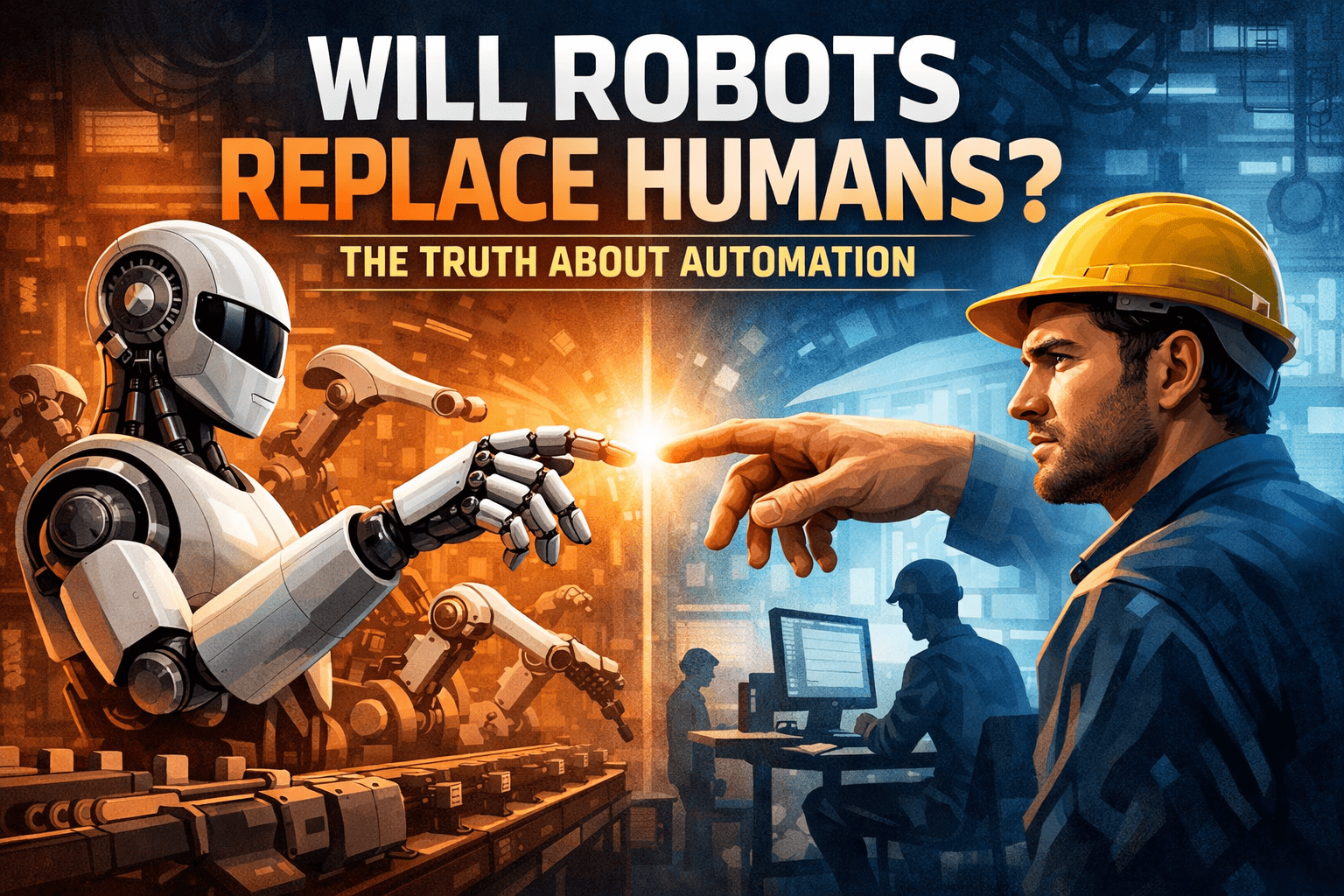
Will robots replace humans? The truth about automation
By Admin • 7 months ago
Many people worry that robots will soon replace humans, leaving the future of human employment uncertain and bleak. This fear stems from advancements in automation technologies, such as robotics for physical tasks, cognitive computing for intellectual tasks, and self-service kiosks for customer service. Artificial intelligence is at the heart of these technologies.
In this post, we explore the question: "Will robots replace human jobs in the future?" The ultimate goal is to help us better understand the topic, expand our knowledge, and prepare for current technological disruptions.
Professionals who combine human creativity with AI are landing some of the world's highest-paying jobs, such as AI ethicists and chief data officers, who earn millions of dollars.
The rise of automation and artificial intelligence (AI) has sparked intense debates about the future of work. While robots and AI-powered systems are transforming industries, the question remains: Will robots replace humans entirely? The answer is complex and depends on several factors, including technological advancements, economic considerations, and the human capacity for adaptation.
The Impact of Automation on Jobs
Automation is not a new phenomenon. From the Industrial Revolution to the digital age, technological advancements have consistently transformed the workforce. Today, AI and robotics are accelerating this transformation across diverse industries, from manufacturing and healthcare to finance and customer service.
Certain repetitive and predictable jobs are more susceptible to automation. For example, factory work, data entry, and retail cashier positions have already undergone significant automation. Self-checkout kiosks, robotic assembly lines, and AI-powered chatbots are replacing many tasks previously performed by humans.
Jobs That Are Safe from Automation
Despite the concerns, not all jobs are at risk. Positions that require creativity, emotional intelligence, and complex problem-solving skills are less likely to be automated. These include roles in healthcare (such as doctors and nurses), education, human resources, and creative industries like writing, design, and filmmaking.
Furthermore, jobs that require human interaction, empathy, and decision-making skills, such as therapists, social workers, and senior management positions, remain difficult for robots to replicate.
The Human-Robot Collaboration
Rather than completely replacing humans, many experts believe automation will lead to a collaborative future where humans and robots work together. AI can handle repetitive tasks, analyze vast amounts of data, and improve efficiency, while humans contribute creativity, critical thinking, and interpersonal skills.
For example, in the medical field, AI helps doctors diagnose illnesses more quickly and accurately. In the business world, AI-powered analytics helps decision-makers optimize their strategies. The key is to leverage automation to enhance human capabilities rather than eliminate them.
The Future Workforce
Now, I'm not saying that robots, in their current state, are useless and have no future, nor that they're so good they'll take our jobs.
Frankly, the possibilities are endless for improving our lives and careers, as mentioned earlier in this article.
Contrary to popular belief, I think robots and AI will create more jobs and improve the ones we already have, not replace them.
According to the World Economic Forum's Future of Jobs Report 2023, the greatest job growth in the coming years is expected to be in positions requiring human skills.
These include vocational training teachers, farm machinery operators, and heavy truck drivers.
These jobs involve physical dexterity, sound judgment, and communication—areas in which humans excel and where robots still fall short. Furthermore, the World Economic Forum predicts that AI will replace more than 85 million jobs, but will create more than 97 million new ones by 2025. This fact also fascinates me, and it's something I've always thought about when reading or listening to critics of robotics and AI.
People, human intuition, and abstract thinking are needed to design, build, manufacture, sell, market, optimize, maintain, and operate these technologies with high efficiency.
We can only expect these roles to proliferate as the technology continues to develop. They are simply tools that allow people to reach their full human potential, but that isn't possible without maintaining a symbiotic relationship with technology.