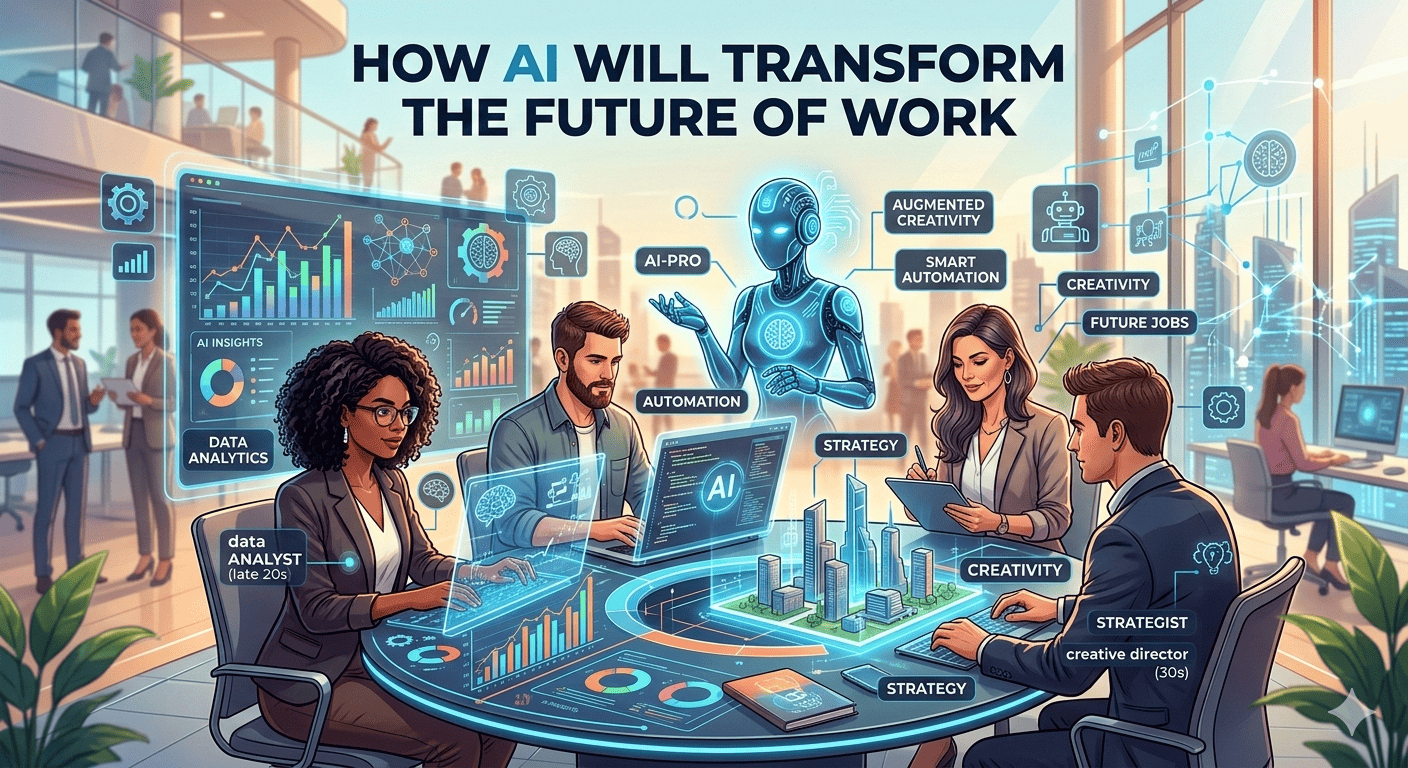
How AI Will Transform the Future of Work
By Admin • 7 months ago
We've been hearing warnings for years that robots could take over our jobs. More recently, a Goldman Sachs report suggested that artificial intelligence (AI) could replace a staggering 300 million full-time jobs. Yet, for many people, work has seemed to go on as usual.
Is this just hype? Or are we finally reaching a tipping point with recent advances in AI? Will AI replace us, or will it actually make us better and faster at what we do?
I met with leading experts and investors to get their take on how AI will change the future of work. Their insights offer a good picture of how they perceive AI will affect our jobs and where they see the greatest future opportunities.
Let's hope for a reversal of roles: soon we will be the ones helping the machines, not the other way around.
Through AI automation, machine learning, and advanced productivity tools, AI empowers one person to do the work of many. Just as industrial machines multiplied physical labor, modern AI technology multiplies human intelligence, boosting business efficiency, workflow automation, and scalable growth in today’s digital economy.
The impact of AI will be as great as the Industrial Revolution, allowing one person to do the work of many.
The impact of AI will be as great as the Industrial Revolution, allowing one person to do the work of many.
Remember The Matrix? The Terminator saga? We grew up with these movies. What did they have in common? Their uncanny predictions about machines that would dominate the world in the future. In today's age of Artificial Intelligence, this future doesn't seem so far off.
As terrifying as this fourth industrial revolution may seem, it's not a completely unknown phenomenon. During the first industrial revolution, machines replaced a large portion of the workforce, but did the human workforce become completely obsolete? No. Similarly, will AI replace humans entirely, or will our species coexist with its last competitor?
This article analyzes the impact of AI on our work dynamics and how we should face this new challenge. Experts have diverse opinions on the matter.
AI will reach all industries
AI is transforming industries right now, not in the distant future. Today, customers expect faster, smarter solutions across all sectors.
This in-depth article illustrates how AI is transforming major industries by 2025, encompassing agriculture, healthcare, manufacturing, and retail. You'll find the latest trends, real-world applications, and ways to integrate AI with your business goals. Your success and business growth depend on understanding the impact of AI, regardless of your industry.
White-collar job functions, from coding to financial and legal services, will be much more efficient.
Most administrative jobs could be automated by artificial intelligence (AI) within the next 12 to 18 months, warned Mustafa Suleyman, Microsoft's director of AI.
These include jobs that currently require a significant amount of professional work, such as document inspection, financial analysis, regulatory compliance checks, marketing optimization, programming, and customer communication, he told the Financial Times.
“Administrative work, where you sit in front of a computer, whether you're a lawyer, accountant, project manager, or marketing specialist, will be completely automated by AI within the next 12 to 18 months,” Suleyman stated.
“Many software engineers report that they already use AI-assisted coding for the vast majority of their code output,” Suleyman said, citing software engineering as an early example.
AD
According to Microsoft's AI director, AI-assisted coding tools now handle most code generation, allowing engineers to focus on high-level activities such as system architecture, debugging, verification, and deployment.
Advances in "professional-level" AI systems are dramatically altering how knowledge workers operate, Suleyman stated.
He added that these systems can perform most human-level job tasks, distinguishing between artificial general intelligence (AGI) and what he termed "superintelligence."
"I prefer the definition that focuses first on what it takes to build a system that can perform most of the tasks a typical professional does on a daily basis. Think of it as professional-level AGI," Suleyman said.
Suleyman stated that the human-level performance standard is being approached faster than expected in several professional fields. "I believe we will achieve human-level performance in most, if not all, professional tasks," he concluded.
AI is already reducing the number of junior and mid-level software developers needed to launch new products.
One immediate impact of large language models (LLMs) is that they are significantly reducing the number of software developers needed to create and launch new digital products. The startups in my portfolio are replacing programmers with copilots. While they still rely heavily on their generals (like CTOs and AI managers), they are realizing they need fewer and fewer soldiers (like programmers and data scientists).
As GenAI disrupts traditional roles, professionals will rely on AI-powered peer-to-peer channels to learn, enhance their skills, and explore new career paths.
As generative artificial intelligence (GenAI) redefines job roles and poses new challenges for workforce adaptation, managers need a clear framework to manage this transformation. This study develops a GenAI-driven work typology, based on individual ambidexterity (AI), that highlights employees' ability to balance exploration and exploitation while managing competing demands. Through a comprehensive literature review and empirical examples, we identify four GenAI-driven work types: Design and Innovation, Data Analysis and Insight Evocation, Customer Service and Engagement, and Content Generation and Optimization.
These types reflect the interplay of two critical AI tensions: specialization (generalist vs. specialist) and task routinization (routine vs. non-routine), offering insights into how employees can adapt their skills and roles. Our findings provide practical recommendations for workforce development, including the design of targeted skills development programs, the implementation of ethical guidelines, and the fostering of empowering organizational environments. Furthermore, we address the psychological and procedural challenges of integrating GenAI into the workplace and propose strategies for aligning workforce transformation with policy objectives. By combining theoretical insights with practical recommendations, this study offers managers a structured roadmap for fostering an ambidextrous and resilient workforce in the GenAI era.
AI is transforming the way organizations make critical decisions
Artificial intelligence is no longer just a buzzword. It now drives some of the most crucial business decisions made by modern leaders. From predictive analytics to intelligent automation, AI empowers executives to make faster, more informed, and data-driven decisions across a wide range of industries.
Leaders are no longer relying solely on intuition. AI-powered insights are guiding corporate strategy, product development, customer experience, and operational efficiency. Companies that fail to adapt risk falling behind as their competitors evolve with greater agility and foresight.
The AI companies that define the category will be those with defense and distribution capabilities.
AI companies are growing at an unprecedented rate. But rapid growth doesn't guarantee lasting success.
So how do we differentiate the companies that are moving toward category leadership from those headed for failure?
It all comes down to long-term defense. Along with scalability, integration, and branding, network effects have been a dominant method for developing startup defenses over the past decade.
But AI has changed the game. It has never been easier to build a company and a product. As a result, some "typical" defense strategies are too slow to compete in this era of rapid AI scaling.
The answer: Multiple short- and long-term defense strategies are needed. Scaling speed is the primary lever, but you must constantly build for the future. Network effects will play a key role in which companies survive this AI boom and become dominant, but they need to be implemented at the right time—as part of a long-term battle strategy.
One way to think of it: Your startup should be like a motte-and-courtyard castle. In medieval warfare, a motte-and-courtyard castle had two distinct defensive positions: the courtyard—a large, easily accessible ground where daily business was conducted and initial battles were fought—and the mote—a heavily fortified tower on a hill where defenders could retreat when the courtyard was overrun. The courtyard was designed to be abandoned when necessary; the mote was built to be impregnable.
For AI startups, your “courtyard” consists of the rapidly deployable defenses that establish your market position: superior distribution, rapid growth, and brand momentum. These allow you to get into the game quickly, but they won’t keep you going indefinitely against determined competitors. Your “mote” is where you retreat as the competition intensifies: true network effects, deep workflow integration, and a systemic lock-in that becomes nearly impossible to dislodge.
The key is knowing when to fight in the yard and when to build the mop.
The infrastructure and research layer of generative AI is where sustainable business models are found.
In recent years, the growing importance of artificial intelligence (AI) and sustainable business models (SBMs) has had a significant impact on various industries. Despite their rapid development, the field remains fragmented, and the evolution of concepts and analytical frameworks has led to a lack of unified understanding. Previous studies have primarily emphasized the technical aspects of AI and business models, often relegating sustainability to a secondary role. Furthermore, uncertainty remains regarding the extent to which AI affects key sustainability indicators. To address these shortcomings, this study systematically reviews 170 articles and proposes two key contributions: first, it identifies and examines emerging trends in AI-driven sustainable business models (SBMs) and provides a structured overview of current research; second, it proposes an integrative framework that incorporates multiple perspectives on AI and sustainable business models, offering insights for addressing managerial challenges. By integrating existing knowledge, this study not only clarifies research gaps, but also outlines a forward-looking agenda to deepen the understanding of AI's role in developing sustainable business practices.
AI makes it harder than ever to identify substances amidst all the noise
AI has accelerated and democratized content creation, but it has also amplified digital noise. With AI-generated content, automated posts, and synthetic media flooding the internet, it is increasingly difficult to identify authentic information and meaningful perspectives.
In today's era of information overload, distinguishing real substance from automated noise requires stronger critical thinking, verification tools, and smart digital literacy.
Large language models are not just hype
Large Language Models (LLMs) are not just a passing fad: they are transforming how we create, analyze, and interact with information.
Powered by natural language processing (NLP) and advanced AI technology, LLMs automate content creation, customer service, coding assistance, and large-scale data analysis. Their real-world applications in business, education, and digital marketing demonstrate that they are practical productivity tools, not just a trend in the AI revolution.
AI will impact our daily work, first gradually and then suddenly.
AI will transform everyday work in much the same way as the Industrial Revolution: gradually at first, then suddenly.
Initially, AI improves small tasks through automation, workflow optimization, and productivity tools. Over time, as its adoption grows, its impact accelerates, transforming industries, redefining job roles, and driving a large-scale digital transformation across the global economy.