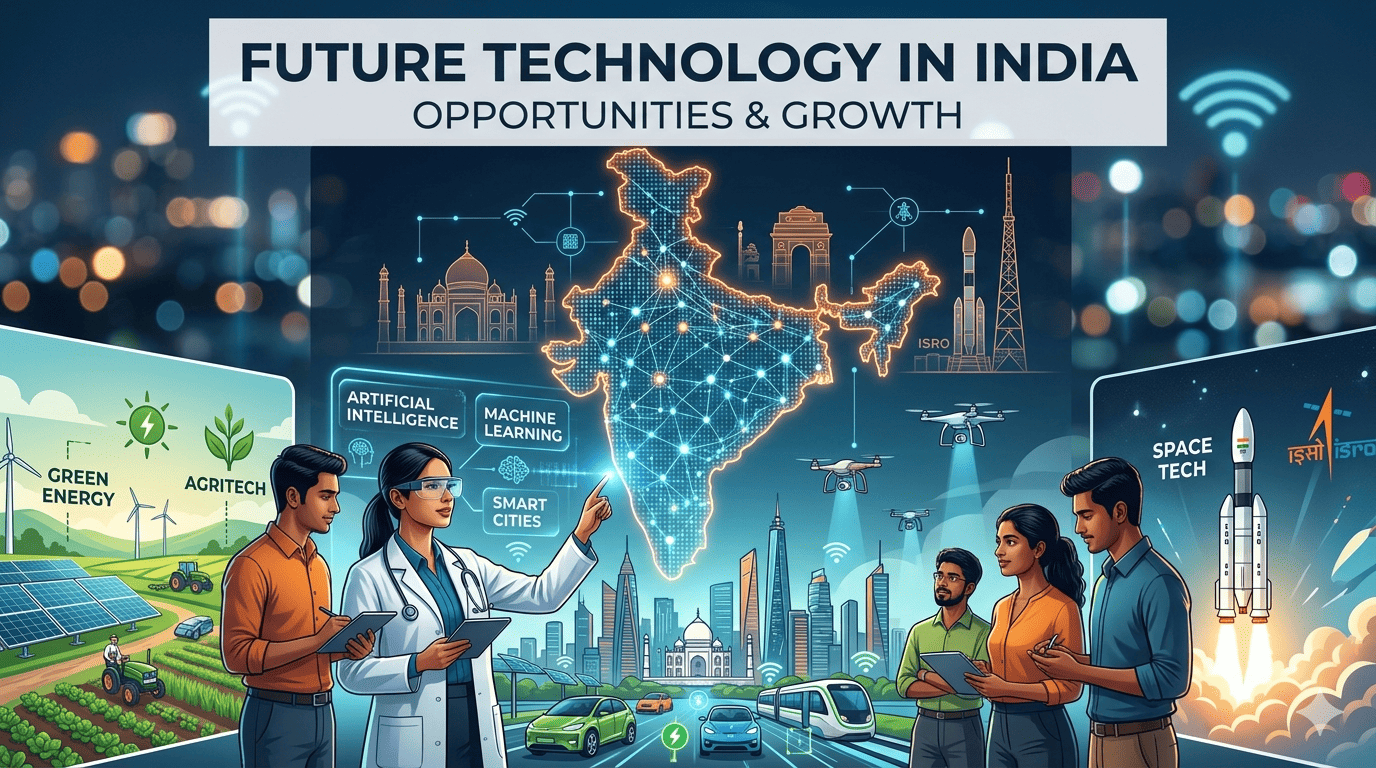
Future Technology in India: Opportunities & Growth
By Admin • 7 months ago
India is rapidly emerging as a global hub for future technologies, driven by innovation, digital transformation, and a strong startup ecosystem. With initiatives from the Government of India and programs like Digital India, the country is investing heavily in areas such as artificial intelligence, renewable energy, biotechnology, and space technology.
India’s tech industry is also supported by major companies like Tata Consultancy Services and Infosys, along with a fast-growing startup ecosystem. These organizations are helping accelerate innovation in AI, fintech, health tech, and smart infrastructure.
Over the next decade, technologies such as AI automation, clean energy solutions, advanced healthcare, and digital workplaces will create new economic opportunities, generate jobs, and strengthen India’s position in the global technology landscape.
Government of India, political authority by which the Republic of India is administered on the basis of the principles of democracy and federalism. The functions of the government are to enact and enforce legislation, formulate and implement policies, and maintain law and order. The Constitution of India is the guiding document for the government. The Government of India was formed in 1950 when the Constitution went into effect, three years after India achieved independence from British rule. In the intervening period, India was governed by existing legislation enacted by the British Parliament.
Democracy in India
In terms of population, India is the world's largest democracy. Its democratic nature is described in the Preamble to the Constitution, which begins:
We the People of India, Having solemnly resolved to establish India as a sovereign, democratic, socialist, secular republic…
The legislative branch, constituted on democratic principles, is composed of representatives elected by universal suffrage: all citizens over the age of 18 are entitled to vote, unless the law prohibits them from exercising this right. Votes are cast for one of the numerous political parties. India follows a multi-party political system, the aim of which is to prevent the supremacy of any single group. Under this system, numerous distinct and officially recognized political parties can be formed, and several candidates can stand for election in the same constituency. The party or coalition of parties that wins the most seats in the legislature forms the government. The elected representatives of the parties that do not win enough seats to form a government constitute the opposition.
Electoral processes and codes of conduct are defined and enforced by the Election Commission of India (ECI), which oversees all elections. Elections to state and union legislatures are generally held at the end of each five-year term, although snap elections may be held if the legislature is dissolved for any reason. By-elections may also be held if a legislative seat becomes vacant due to the death or resignation of the incumbent.
The Election Commission of India (ECI) also has the authority to register and recognize political parties. Parties wishing to participate in elections must register with the ECI, which may grant them recognition based on certain criteria. Recognized parties receive exclusive symbols and tax exemptions on donations, as well as 40 prominent spokespeople during elections. They also receive airtime on national television and radio networks. Unrecognized but registered parties are also exempt from donation taxes, can choose from a list of common symbols, and have 20 prominent spokespeople.
Digital India
Digital India is a flagship government initiative launched in 2015 to transform India into a digitally empowered society and a knowledge economy. It seeks to leverage information and communication technologies to improve governance, promote inclusion, and deliver efficient services to all citizens.
Key facts
Launched: July 1, 2015
Parent ministry: Ministry of Electronics and Information Technology
Implementing body: Digital India Corporation
Estimated budget (initial phase): ₹1.13 lakh crore
Core focus: Digital infrastructure, e-governance, and citizen empowerment
Vision and objectives
Digital India seeks to close the digital divide and create accessible, efficient, and transparent governance. Its core vision revolves around three pillars: (1) digital infrastructure as a public service for all citizens, (2) on-demand governance and services, and (3) digital empowerment of citizens. It promotes universal access to broadband, secure digital identities, paperless service delivery, and multilingual digital literacy initiatives.
Structure and implementation
The program operates under the coordination of the Ministry of Electronics and Information Technology. Digital India Corporation (DIC), a non-profit (Section 8) company, acts as its implementing arm. DIC oversees several specialized divisions, including the National E-Government Division (NeGD), MyGov, India AI, the Indian Semiconductor Mission, the Ministry of Electronics and Information Technology's Entrepreneurship Centre (MeitY Startup Hub), and Digital India Bhashini, which together drive innovation, e-government, and technology incubation.