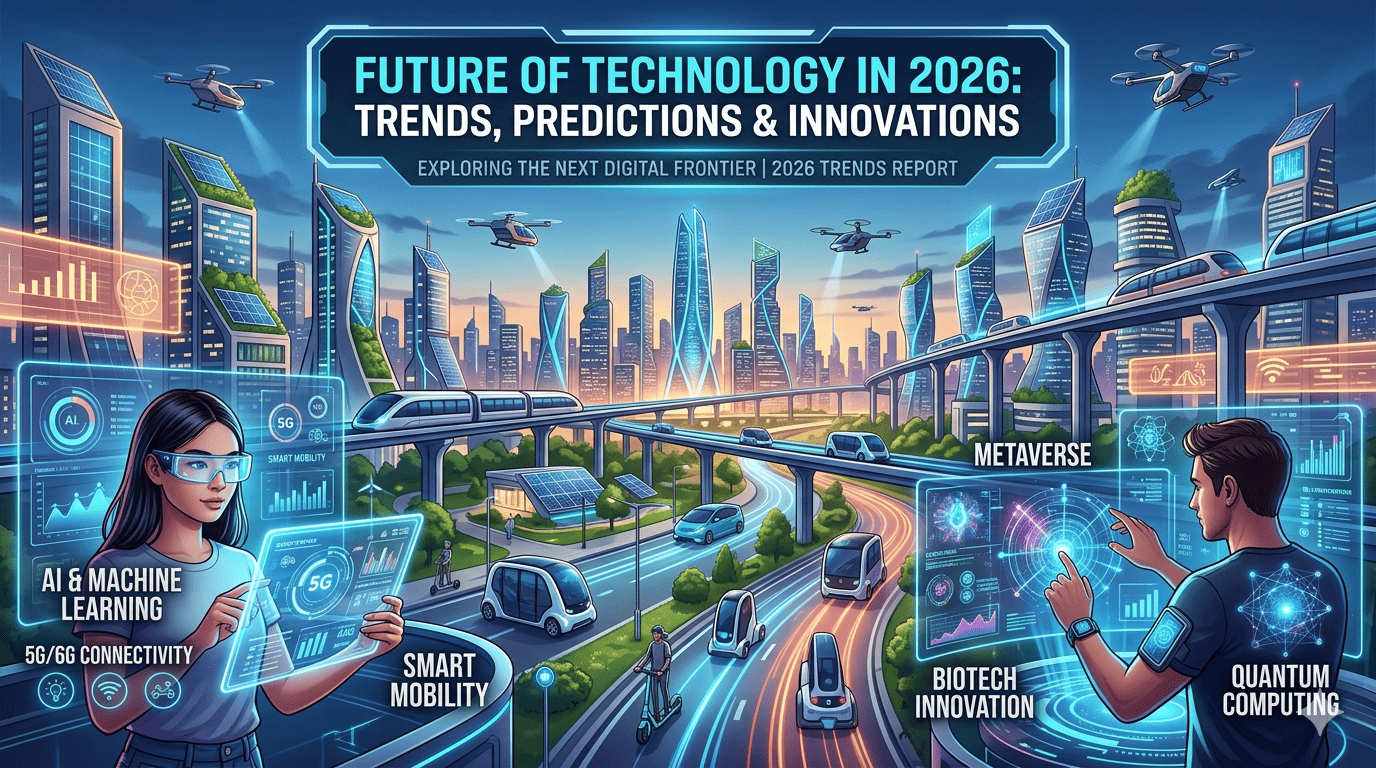
Future of Technology in 2026: Trends, Predictions & Innovations
By Admin • 7 months ago
The year 2026 promises to be a pivotal moment for the global technology ecosystem. As digital transformation accelerates across all sectors, organizations face both unprecedented
opportunities and new challenges. The convergence of artificial intelligence (AI), quantum computing, the Internet of Things (IoT), edge computing, and blockchain is transforming business
models and redefining competitive advantage. For technology professionals, analysts, and executives, understanding emerging trends and strategic priorities is essential to staying ahead in
this dynamic environment.
1. The Rapid Growth of AI
a. AI development has accelerated dramatically in recent years. Technologies like:
b. Machine Learning
c. Natural Language Processing
d. Robotics
e. Generative AI
f. Computer Vision
g. are now integrated into many industries.
h. Examples include:
i. AI chatbots in customer service
ii. Self-driving vehicle research
iii. AI-powered healthcare diagnostics
iv. Automated manufacturing
Businesses are investing billions of dollars into AI to increase efficiency and reduce operational costs.
2. How AI is Disrupting Industries
a. AI is already disrupting many traditional industries.
b. Manufacturing
c. Factories now use robotic automation to assemble products faster and with fewer errors.
d. Healthcare
e. AI helps doctors detect diseases like cancer earlier using medical imaging analysis.
f. Finance
g. Banks use AI to detect fraudulent transactions and manage risk.
h. Marketing
i. AI tools analyze consumer behavior to create targeted advertising campaigns.
j. Because of these changes, some repetitive jobs are being automated.
3. Will AI Replace Human Jobs?
AI will replace some tasks, but not all jobs.
Jobs most likely to be automated:
a. Data entry
b. Basic customer support
c. Manufacturing assembly
d. Simple accounting tasks
e. Jobs that are safer:
f. Creative work
g. Strategic decision making
h. Leadership roles
i. Emotional intelligence jobs (teachers, therapists)
Instead of replacing humans completely, AI is changing job roles.
Why These Technology Trends Matter Now
Technology leaders face a pivotal year. These trends are not just technical changes, but strategic imperatives. CIOs who act now will be better positioned to:
Align digital strategy with business objectives
Scale AI safely and responsibly
Overcome geopolitical and regulatory complexity
Lead transformation with confidence
This year’s trends are tightly intertwined and reflect the realities of a world where no capability is ever enough. Gartner organizes them into three themes that define how leading organizations will innovate, compete, and protect value: The Architect, The Synthesizer, and The Vanguard.
Looking to translate strategy into technical execution?
Explore Gartner’s Technical Implementation Strategy for CIOs, where you’ll find practical guidance for technical teams on building resilient, scalable systems and aligning their technology initiatives with mission-critical objectives.
The Architect: AI Platforms and Infrastructure
These trends focus on building secure and scalable foundations for AI and digital transformation:
Native AI development platforms enable small, agile teams to create generative AI software that is fast, flexible, and increasingly enterprise-ready.
AI supercomputing platforms enable advancements in model training and analysis but require rigorous governance and cost control.
Secret computing protects sensitive data during use, enabling secure AI and analytics on untrusted infrastructures.
The Synthesizer: AI Application and Orchestration
These trends highlight how to combine specialized models, agents, and physical-digital systems to create new value: Cutting Edge: Security, Trust, and Governance
Multi-agent systems allow modular AI agents to collaborate on complex tasks, improving automation and scalability.
Domain-specific language models offer greater accuracy and regulatory compliance for industry-specific use cases. Physical AI brings intelligence to the real world, powering robots, drones, and smart equipment for operational impact.
A global technology leader specializing in hardware, software, and telecommunications equipment for networks responded to the growing need for risk management in the global supply chain with a comprehensive, risk-based cybersecurity strategy built on governance and collaboration. Their approach focuses on two fundamental pillars: defining and mitigating risk.
Interdisciplinary teams jointly assess key factors, such as site activity, IP volume, connectivity, and location, to establish risk tolerance levels and prioritize high-value partners. A dedicated supply chain security team ensures regulatory compliance, manages access, and implements data protection controls. Ongoing collaboration with the central security department ensures that policies are practical and enforceable.
These trends address the growing need to protect reputation, ensure regulatory compliance, and maintain stakeholder trust:
Preventive cybersecurity transforms defense from reactive to proactive, using AI to block threats before they strike.
Are you a technology provider? Consult Gartner’s proactive cybersecurity guide for technology vendors. Digital provenance verifies the origin and integrity of AI-generated software, data, and content, which is essential for trust and regulatory compliance.
AI security platforms centralize visibility and control across third-party and custom AI applications.
Geopatriation helps organizations mitigate geopolitical risk by transferring workloads to sovereign or regional cloud providers.
Download the full ebook, "Top Strategic Technology Trends for 2026," to explore the 10 trends and gain practical guidance for 2026 and beyond.
Are you a CIO or IT leader at a midsize company?
See how your peers are addressing AI adoption, vendor decisions, and evolving business demands, with tools tailored to your role:
Explore our resources for midsize companies.
See a curated list of Gartner’s most popular research used by your peers.